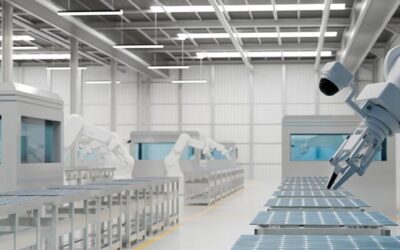
The photovoltaic conversion efficiency of chalcogenide solar cells has skyrocketed from 3.8% to 25.5%, making this technology a bright new star in the field of solar energy. This high efficiency is achieved by stacking multiple chalcogenide-based semiconductor layers in tandem, allowing the cell to absorb more wavelengths of light than can be achieved with a single-layer cell.
Challenge
Large-scale industrialization of tandem solar cells depends on advancements in the technology used to prepare thin chalcogenide films. Limitations of the traditional spin-coating process have hindered mass production of these films. The introduction of new coating and printing technology offers new hope for the large-scale production of chalcogenide thin films, but success depends on precise control of chalcogenide crystallization kinetics.
In a coating process that must run at low speeds, the challenge before engineers is how to achieve high-precision speed control. Like a painter’s brushstroke, but on a microscopic scale, the uniformity of the coating solution depends on delicate and precise control. Any tiny fluctuation in speed can lead to uneven coating, which affects the quality of the chalcogenide film and the performance of the solar cell. At low speeds, achieving the required smoothness of motion is a severe test for conventional servo motor systems.
Solution
A major solar-cell manufacturer sought to solve the challenge of high-precision speed control for its slit coating process for large-area chalcogenide film preparation. This process depends on the smoothness of a moving platform to ensure a uniform coating at the slow speed of 1–12 mm/s. To solve this demanding challenge, Kollmorgen’s motion specialists recommended a direct drive linear solution using IL Ironless DDL motors paired with AKD servo drives.
In a traditional slotted motor, copper coils are wound in the slots between laminated steel teeth, which create an inherent attractive force between the coil assembly and the magnet way, even when the coils are not powered. At slow speeds, this inherent attraction can cause cogging. In IL Ironless DDL motors, the coil assembly has no laminated steel teeth. This means there are no attractive forces other than those generated by commutation of the winding phases. This design results in a zero-cogging motor, even at low speeds. Additional benefits for this application include exceptionally lightweight moving parts, low heat generation, reduced energy losses and improved motion-system responsiveness and dynamics, all enabling these motors to perform every subtle movement in the coating process with extreme smoothness and precision.
AKD drives offer exceptionally high-speed refresh frequency and optimized performance tuning, including filters that compensate for the effects of both flexible and rigid connectors. With precise current, speed and position control for IL Ironless DDL motors, speed fluctuations are limited to no more than 0.2% at 100 mm/s and 2.5% at low speeds of 10 mm/s. This extreme precision control ensures uniformity of the chalcogenide coating.
Results
With Kollmorgen’s direct drive solution, the customer gained significant improvements in coating speed and uniformity and also realized a significant increase in productivity for the mass production of calcium titanium ore solar cells.
This article came from the Kollmorgen Success Stories
As a Gold Partner, Micromech are able to supply and provide expertise on Kollmorgen products. Need assistance with a new project? Contact our engineers and we can get the ball rolling.