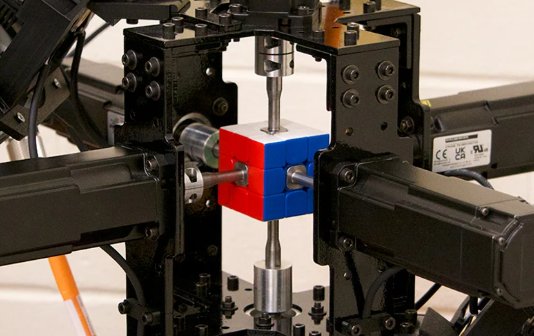
A recent white paper from Kollmorgen highlights how commercially available motion control technology enabled the World’s Fastest Cube-Solving Robot.
Built by a team of engineering students, the robotic system achieved an astonishing 0.103-second solve time, demonstrating what is possible when high-performance servo systems, precision tuning, and optimized mechanical design converge.
Rather than relying on custom-built motion hardware, the team implemented a complete off-the-shelf motion platform — proving that commercially available servo motors, drives, and coordinated multi-axis control can deliver extreme acceleration, synchronization accuracy, and rapid settling performance.
Why This Matters
The project reinforces several key engineering principles:
-
Motion system performance should be prioritized early in machine design
-
Multi-axis synchronization is critical in ultra-high-speed automation
-
Proper tuning and system optimization unlock full hardware capability
-
Commercial motion platforms are capable of world-record performance
For organizations developing high-speed automation, robotics, or precision machinery, this case study of the World’s Fastest Cube-Solving Robot demonstrates how selecting the right motion architecture can dramatically influence overall system capability.
👉 Read the full white paper here