As industrial automation continues to evolve, machine builders and manufacturers face an important question: is a robot always the best solution, or could a dedicated servo-driven machine deliver better performance?
Robotics has transformed modern manufacturing, offering flexibility, efficiency and the ability to automate increasingly complex tasks. However, introducing a robot does not automatically guarantee greater accuracy, faster production or improved productivity.
The right solution depends on the application’s specific motion requirements, including speed, precision, repeatability and flexibility.
In this article, inspired by insights from Trio Motion Technology, we explore the differences between robotic systems and dedicated motion-controlled machines, and how to determine the most suitable approach for your automation application.
At a Glance: Robot vs Machine
Industrial Robots
Flexibility and Versatility
Industrial robots offer flexible multi-axis movement, making them suitable for material handling, pick-and-place operations and applications requiring frequent changes in positioning or tasks.
Servo-Driven Machines
Precision and Synchronisation
Dedicated servo-driven machines can be optimised for accurate, repeatable and synchronised motion, making them ideal for high-speed production and precision manufacturing processes.
Integrated Solutions
The Best of Both Technologies
Combining robotics with dedicated motion control can deliver flexibility and precision, allowing machine builders to coordinate different operations within a single automation system.
Application Requirements
Selecting the Right Solution
Consider speed, accuracy, repeatability, flexibility and integration requirements when choosing between robotic systems and dedicated motion-controlled machinery.
Understanding the Difference Between Robots and Servo-Driven Machines
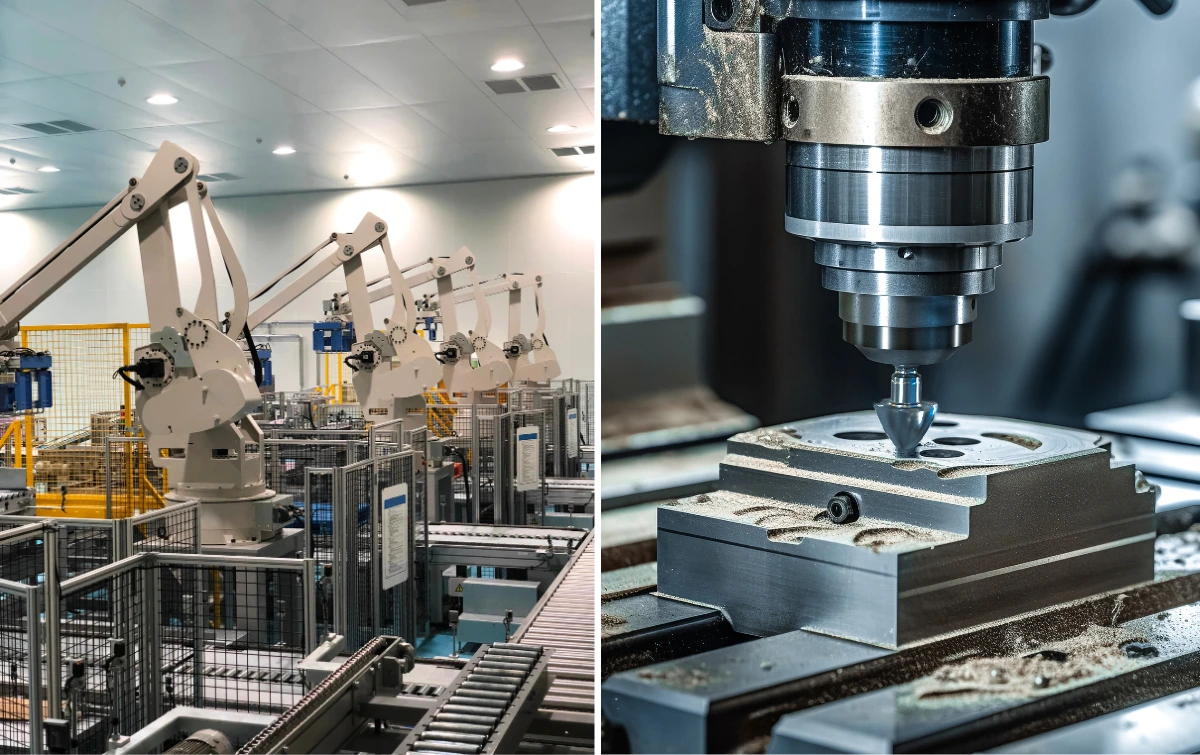
Although both technologies use motion control to automate industrial processes, their mechanical configurations and operating characteristics can be quite different.
Industrial robots typically use multiple interconnected axes to perform movements across a defined working area. They are particularly suited to applications requiring flexible positioning, handling and movement between different locations.
Servo-driven machines, on the other hand, are often designed around a specific manufacturing process. Their motion systems can be optimised for highly accurate, synchronised and repeatable movements.
Neither approach is universally better. The choice depends on what the machine needs to achieve.
When Is a Servo-Driven Machine the Better Choice?
For applications requiring high-speed, coordinated motion, a purpose-built servo-driven machine can offer significant advantages.
Where movements follow a structured, repetitive sequence, dedicated motion control allows engineers to optimise the complete motion cycle, achieving accurate positioning, synchronisation and consistent performance.
✓ High-Speed Packaging
Synchronised axes maintain accurate positioning and timing throughout the production process.
✓ Precision Cutting
Coordinated movement enables controlled tool paths and consistent results.
✓ Automated Assembly
Repeatable positioning supports consistent component placement and manufacturing quality.
✓ Printing and Converting
Accurate speed and position synchronisation helps maintain registration and process consistency.
In these applications, motion performance often depends on how effectively individual axes work together.
A dedicated motion controller can coordinate servo motors and other motion components to achieve precise, repeatable movements without introducing unnecessary mechanical complexity.
Where Do Industrial Robots Excel?
Industrial robots offer particular advantages where flexibility and movement across multiple positions are essential.
Unlike a machine designed around a fixed process, a robotic system can often be reprogrammed to perform different operations or accommodate changing production requirements.
✓ Pick-and-Place Operations
Flexible positioning allows robots to transfer components and products between different locations.
✓ Material Handling
Robots can automate loading, unloading and product movement, reducing repetitive manual handling.
✓ Machine Tending
Robotic systems can load and unload CNC machines and other production equipment.
✓ Flexible Assembly
Programmable movements allow robots to accommodate different components, product configurations and assembly tasks.
Robots can be particularly valuable when manufacturers need to handle different product sizes, configurations or production sequences.
However, robotic flexibility must be balanced against the application’s required speed, accuracy, payload and operating environment.
Combining Robotics and Motion Control
For some applications, the most effective solution is not a choice between a robot and a machine, but a combination of both.
A dedicated machine may perform the primary manufacturing process, while a robot handles supporting operations such as component loading, product transfer or inspection.
For example, a SCARA robot could load components onto a production line while servo-driven axes manage the precision manufacturing process.
Integrating these technologies requires effective communication and synchronisation between the robot and the machine.
Where supported by the chosen system, a common motion control platform can simplify integration by coordinating robotic and machine axes within a single control environment.
This approach can reduce the complexity associated with separate control systems and help improve overall machine coordination.
Why Motion Control Is Central to the Decision
Whether an application uses a robot, a dedicated machine or a combination of both, motion control remains fundamental to performance.
Before selecting the technology, machine builders should evaluate several important factors to ensure the solution meets their operational requirements.
Speed & Cycle Time
Consider the required production speed and how optimised motion profiles and synchronised axes can improve cycle times.
Accuracy & Repeatability
Evaluate positioning accuracy, repeatability and feedback requirements to ensure consistent performance throughout the production process.
Flexibility
Consider whether the system needs to accommodate different products, movements or changing production requirements.
Axis Coordination
Determine how many axes must operate together and the level of synchronisation required for smooth, controlled motion.
Integration & Maintenance
Assess programming, commissioning, maintenance and future expansion requirements to simplify integration and long-term operation.
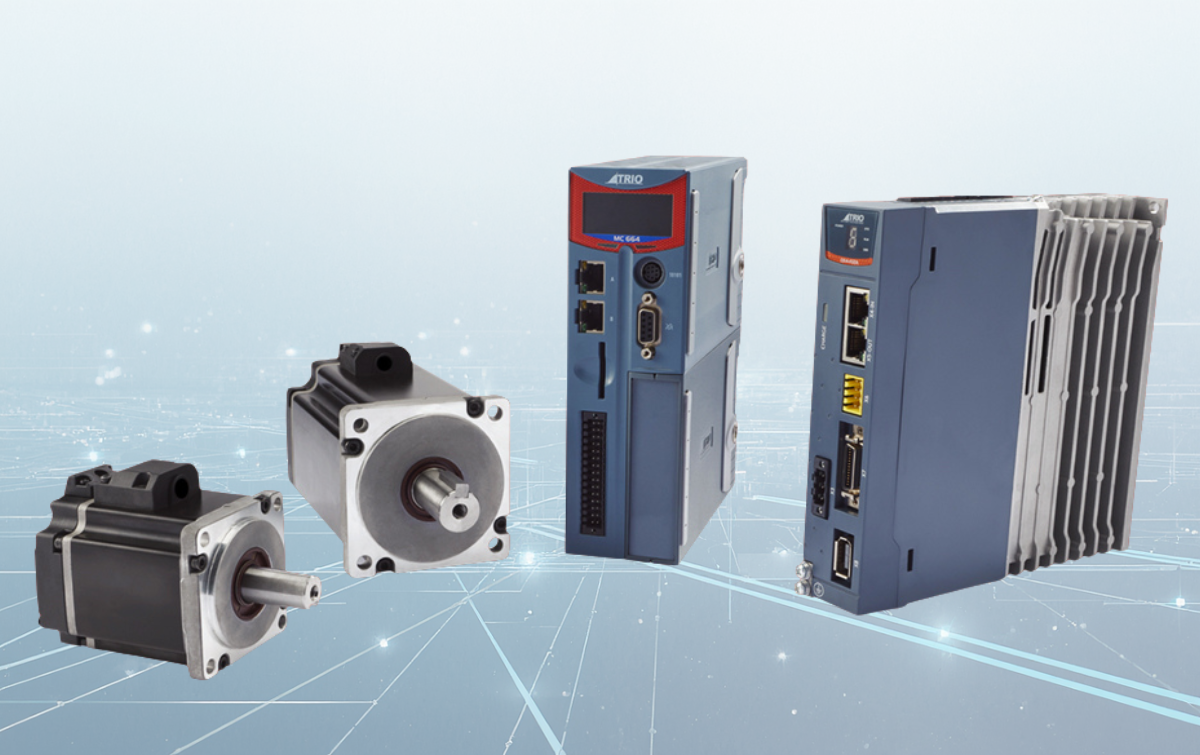
Trio Motion Technology: Integrated Motion and Robotics Control
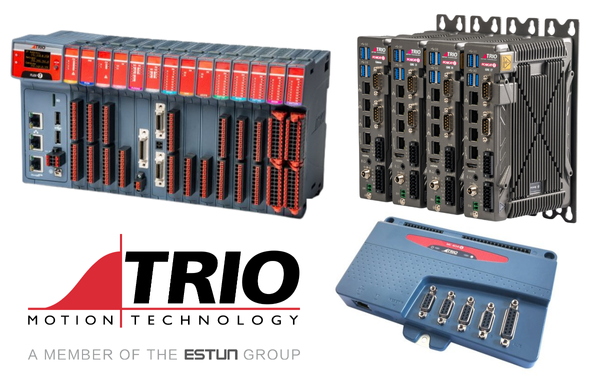
Trio Motion Technology develops advanced motion control solutions for applications requiring precise, coordinated movement.
Its motion controllers support a wide range of industrial automation requirements, from individual servo axes to complex multi-axis systems.
Using technologies such as EtherCAT, Trio solutions enable high-speed communication and synchronisation between compatible motion control components.
Trio’s integrated approach can also support machine and robotic motion within a common control environment, helping machine builders simplify development and improve coordination.
As a UK Trio Solutions Partner, Micromech supplies and supports Trio Motion Technology products, helping engineers specify suitable motion control solutions for their applications.
Explore Trio Motion Technology solutions at Micromech:
https://www.micromech.co.uk/suppliers/trio/
Conclusion: Choosing the Right Motion Solution
Choosing between an industrial robot and a dedicated servo-driven machine is not simply a question of which technology is more advanced. It is about identifying the solution that best meets the application’s performance, flexibility and production requirements.
Robots can provide the versatility needed for changing tasks and complex handling operations, while dedicated motion-controlled machines can deliver highly optimised, synchronised movement for specific manufacturing processes.
In some applications, combining both technologies offers the most effective approach.
By considering speed, accuracy, repeatability, flexibility and integration requirements from the outset, machine builders can develop automation systems that deliver reliable, efficient and consistent performance.
This article was inspired by “What’s better: a robot or a machine?” by Tom Alexander, published on the Trio Motion Technology blog.
Original article: What’s better: a robot or a machine?
Need help selecting the right motion control solution?
Micromech’s experienced engineers can help you evaluate your application’s requirements and specify suitable motion controllers, servo drives, motors and integrated automation solutions.