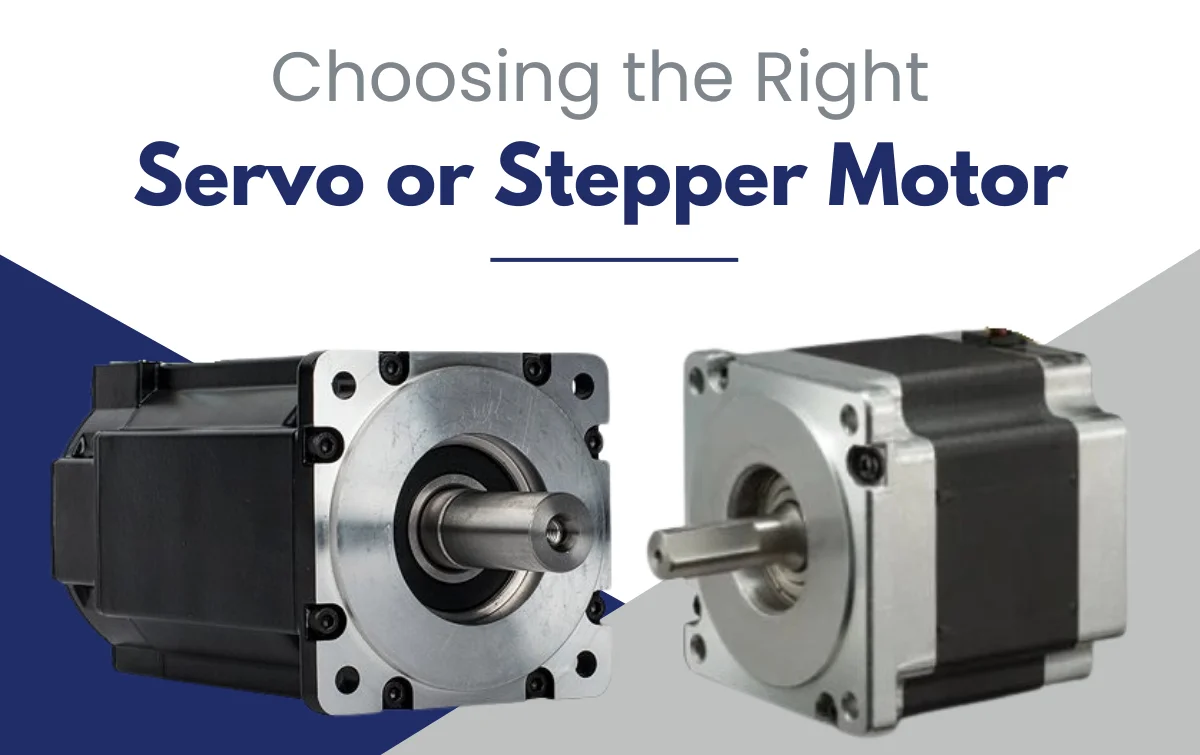
Selecting the right motor is essential for achieving the performance, precision and reliability your application demands. While both servo and stepper motors are widely used in motion control systems, each offers unique advantages depending on factors such as speed, torque, positioning accuracy, load characteristics and budget.
This guide explains the key differences between servo and stepper motors, helping you understand when each technology is the best choice and how to select the most suitable solution for your application.
Servo vs Stepper: At a Glance
Compare the key characteristics of servo and stepper motors to help identify the most suitable solution for your application.
Servo Motors
✓ High-speed performance
✓ Excellent positioning accuracy
✓ Closed-loop feedback
✓ Suitable for dynamic loads
✓ Ideal for demanding automation
Stepper Motors
✓ Simple open-loop control
✓ High holding torque
✓ Cost-effective solution
✓ Well suited to lower speeds
✓ Ideal for indexing applications
How They Work
Although servo and stepper motors are both used for precise motion control, they operate in fundamentally different ways. Understanding these differences will help you select the most suitable technology for your application’s performance, accuracy and cost requirements.
Servo Motors
Operate using closed-loop feedback.
The motor continuously monitors its position and automatically corrects any deviation, providing excellent accuracy, smooth motion and high-speed performance.
Stepper Motors
Operate using open-loop control.
The motor moves in fixed increments without feedback, making it a simple, reliable and cost-effective solution for many positioning applications.
Servo Motors
Servo motors use closed-loop feedback to deliver high levels of precision, speed and dynamic performance. They are the preferred choice for demanding motion control applications where accuracy and responsiveness are critical.
What is a Servo Motor?
A servo motor is a closed-loop motion control system that uses continuous feedback from an encoder or resolver to precisely control position, speed and torque. This feedback allows the controller to automatically correct any deviation, delivering highly accurate positioning, smooth motion and reliable performance. Servo motors are ideal for applications requiring high speeds, changing loads and precise control.
Advantages
✓ High positioning accuracy
✓ Excellent speed and torque control
✓ Smooth, responsive motion
✓ Performs well at high speeds
✓ Adapts to changing loads
✓ Ideal for complex motion control applications
Typical Applications
- Robotics and automation
- CNC machinery
- Packaging equipment
- Pick-and-place systems
- Medical devices
- Inspection and test equipment
Stepper Motors
Stepper motors move in precise, fixed increments without requiring continuous position feedback. They offer a simple, cost-effective solution for applications requiring accurate positioning at lower speeds and are widely used in automation, laboratory equipment and positioning systems.
What is a Stepper Motor?
A stepper motor is an open-loop motion control system that rotates in fixed angular steps. Each electrical pulse moves the motor by a precise increment, allowing accurate positioning without the need for an encoder or feedback device in many applications. Stepper motors are valued for their simplicity, repeatability and cost-effectiveness, making them an excellent choice for applications requiring controlled movement at lower speeds.
Advantages
✓ Excellent positioning repeatability
✓ Simple open-loop control
✓ Cost-effective solution
✓ High holding torque at standstill
✓ Easy to integrate into control systems
✓ Ideal for lower-speed positioning applications
Typical Applications
- Laboratory and analytical equipment
- 3D printers
- CNC routers and engravers
- Textile machinery
- Valve and damper control
- Laboratory automation
Choosing the Right Motor
Choosing between a servo and stepper motor depends on the performance requirements of your application. Speed, torque, accuracy, load characteristics and budget should all be considered when selecting the most suitable motor technology.
Choose a Servo Motor When…
✓ High positioning accuracy is critical
✓ High-speed operation is required
✓ Loads vary during operation
✓ Rapid acceleration is required
✓ Continuous position feedback is required
✓ Complex motion control is required
Choose a Stepper Motor When…
✓ The application operates at lower speeds
✓ Loads are relatively predictable
✓ Simple, repeatable positioning is required
✓ High holding torque is important
✓ Cost and system simplicity are priorities
✓ Open-loop control is suitable
Key Differences: Servo vs Stepper Motors
Servo and stepper motors can both provide precise motion control, but their performance characteristics differ significantly. The comparison below highlights the main factors to consider when selecting the right motor for your application.
Consideration
Servo Motor
Stepper Motor
Control
Closed-loop feedback
Typically open-loop
Accuracy
Very high positioning accuracy
Good positioning accuracy
Speed
Performs well at high speeds
Best suited to lower speeds
Torque
Strong torque across a wide speed range
High holding torque; torque reduces as speed increases
Load Changes
Adapts well to changing loads
Best with predictable loads
Complexity
More complex control system
Simpler control system
Cost
Generally higher
Generally lower
Need Help Choosing the Right Motor?
Our team can help you select the right servo or stepper motor for your application, taking into account speed, torque, accuracy, load requirements and control complexity.
Key Differences: Servo vs Stepper Motors
Servo and stepper motors can both provide precise motion control, but their performance characteristics differ significantly. The comparison below highlights the main factors to consider when selecting the right motor for your application.
Control
Servo Motor: Closed-loop feedback
Stepper Motor: Typically open-loop
Accuracy
Servo Motor: Very high positioning accuracy
Stepper Motor: Good positioning accuracy
Speed
Servo Motor: Performs well at high speeds
Stepper Motor: Best suited to lower speeds
Torque
Servo Motor: Strong torque across a wide speed range
Stepper Motor: High holding torque; torque reduces as speed increases
Load Changes
Servo Motor: Adapts well to changing loads
Stepper Motor: Best with predictable loads
Complexity
Servo Motor: More complex control system
Stepper Motor: Simpler control system
Cost
Servo Motor: Generally higher
Stepper Motor: Generally lower