Backlash is an important consideration when selecting a gearbox for a precision motion control application. Even a small amount of movement within the gearbox can affect positioning accuracy, repeatability and the overall performance of a servo system.
Understanding what backlash is, why it occurs and how it affects motion can help engineers select the right gearbox for their application.
At a Glance
WHAT IS BACKLASH?
Small amounts of movement between mating gear teeth when the direction of rotation changes.
WHY IT MATTERS
Backlash can affect positioning accuracy and repeatability in precision motion systems.
WHEN IT MATTERS MOST
Applications with frequent direction changes, precise positioning or highly dynamic motion.
HOW TO REDUCE IT
Correct gearbox selection, low-backlash designs and appropriate system sizing can minimise its effect.
What Is Backlash?
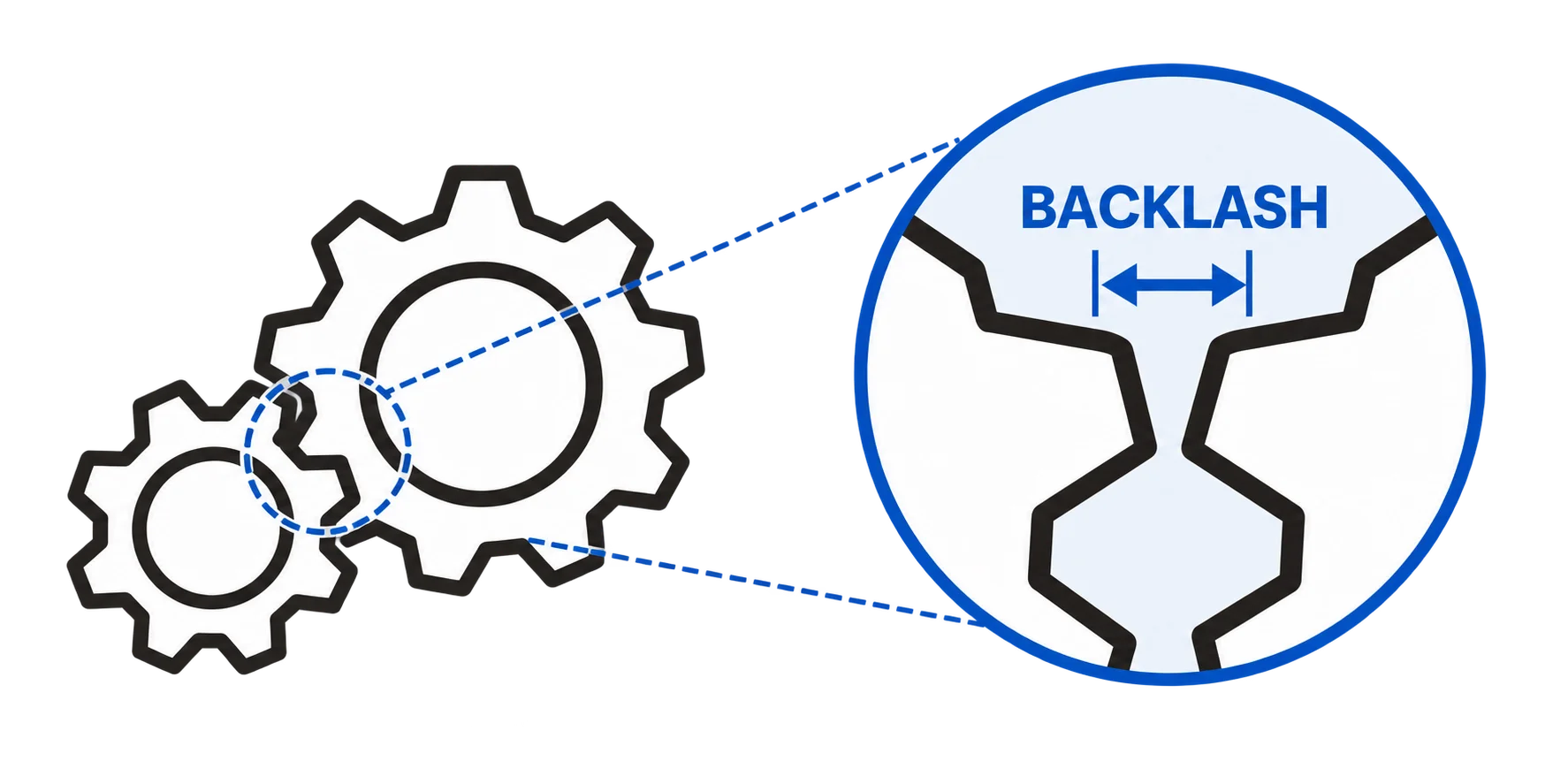
Backlash is the small amount of free movement that can occur between mating gear teeth when the direction of rotation changes.
Within a gearbox, a small clearance is required between gear teeth to allow the gears to operate correctly. When the direction of rotation reverses, the driving gear must move through this clearance before the opposing tooth surfaces make contact and begin transmitting motion in the new direction.
In many applications this movement may have little effect. However, in precision servo systems, even a small amount of backlash can influence positioning accuracy, repeatability and the response of the machine.
Why Backlash Matters in Servo Applications
Backlash becomes particularly important in servo systems because these applications often rely on precise, repeatable movement. When the motor changes direction, any clearance within the gearbox must be taken up before the output begins to move in the opposite direction.
This small amount of lost motion can affect the accuracy and responsiveness of the motion system, particularly where frequent reversing, precise positioning or coordinated movement is required.
POSITIONING ACCURACY
Backlash can cause a small difference between the commanded position and the actual output position.
REVERSING MOTION
The effect of backlash becomes more noticeable when the gearbox frequently changes direction.
REPEATABILITY
Excessive backlash can make it more difficult for a system to return consistently to the same position.
DYNAMIC RESPONSE
Low backlash can help improve the responsiveness and control of high-performance servo systems.
Where Backlash Matters Most
Backlash is not equally critical in every application. Its impact becomes more significant where the motion system requires high positioning accuracy, frequent changes in direction or precise synchronisation between axes.
✓ CNC and machine tool positioning
✓ Robotics and automated handling
✓ Pick-and-place systems
✓ Packaging machinery
✓ Printing and converting equipment
✓ Inspection and measurement systems
✓ Multi-axis motion applications
How to Reduce Gearbox Backlash
Backlash cannot always be eliminated completely, but its effect can be minimised through correct gearbox selection, system sizing and mechanical design. The level of backlash required will depend on the accuracy, repeatability and dynamic performance of the application.
✓ Select a Low-Backlash Gearbox
Choose a gearbox designed for precision servo applications where positioning accuracy and repeatability are important.
✓ Size the Gearbox Correctly
Ensure the gearbox is suitable for the required torque, speed, duty cycle and dynamic loads.
✓ Consider Torsional Rigidity
Higher torsional rigidity helps reduce gearbox deflection under load and can improve the responsiveness of the servo system.
✓ Check the Complete Drivetrain
Couplings, shafts, bearings and other mechanical components can also introduce lost motion or compliance into the system.
✓ Match Performance to the Application
Extremely low backlash is not necessary for every application. Select a gearbox that provides the level of precision the machine actually requires.
How Is Gearbox Backlash Measured?
Backlash in precision gearboxes is typically specified as an angular measurement, usually in arcminutes (arcmin). One arcminute is equal to 1/60th of a degree.
A lower arcminute value indicates less rotational movement between the input and output before the gear teeth engage when the direction of rotation changes.
For example, a gearbox specified with 3 arcmin of backlash allows a smaller amount of lost motion than one specified with 10 arcmin. However, the lowest possible backlash is not always necessary — the appropriate specification depends on the positioning accuracy and performance required by the application.
UNDERSTANDING ARCMINUTES
1° = 60 arcmin
1 arcmin = 0.0167°
Choosing the Right Level of Backlash
The amount of backlash that is acceptable depends on the requirements of the application. While very low backlash is important for highly precise motion, specifying a gearbox with the lowest possible backlash is not always necessary.
When selecting a gearbox, consider the required positioning accuracy, frequency of direction changes, load conditions and overall performance of the motion system.
STANDARD MOTION
For applications where precise positioning is less critical and changes in direction are relatively infrequent, a higher level of backlash may be acceptable.
PRECISION MOTION
Applications requiring accurate positioning, good repeatability or frequent reversing will typically benefit from a low-backlash gearbox.
HIGH-PRECISION MOTION
Robotics, machine tools, inspection systems and other demanding applications may require very low backlash to achieve the required level of motion accuracy.
Backlash vs Lost Motion
Although the terms backlash and lost motion are sometimes used interchangeably, they do not describe exactly the same thing.
Backlash refers specifically to the mechanical clearance between mating gear teeth, which becomes apparent when the direction of rotation changes.
Lost motion is a broader measurement that can include backlash as well as other effects within the drivetrain, such as elastic deformation, torsional compliance and movement within bearings or couplings.
For precision servo applications, it is therefore important to consider the performance of the complete mechanical system rather than looking at the gearbox backlash specification alone.
Selecting a Gearbox for Low-Backlash Applications
When selecting a gearbox for a precision servo application, backlash should be considered alongside the other mechanical and performance requirements of the system. Choosing a gearbox based on backlash alone may not provide the best overall solution.
Key factors to consider include:
✓ Required positioning accuracy and repeatability
✓ Maximum and continuous torque
✓ Motor speed and required gear ratio
✓ Torsional rigidity
✓ Load inertia and acceleration requirements
✓ Duty cycle and operating conditions
✓ Available mounting space and gearbox configuration
The correct balance of these factors will help ensure the gearbox provides the required precision, responsiveness and service life for the application.
Need Help Choosing the Right Gearbox?
Selecting the correct gearbox depends on the complete motion system, including motor speed, torque, gear ratio, inertia, backlash, duty cycle and application requirements.
Micromech can help you select a gearbox with the appropriate backlash, performance and specification for your application.